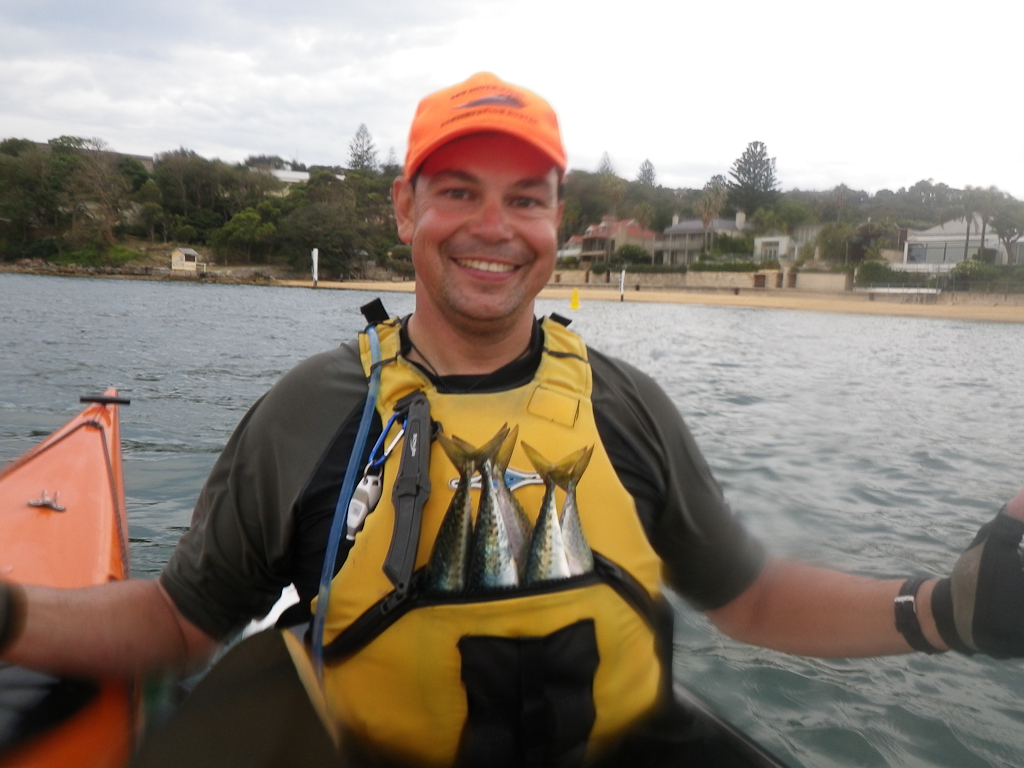
Forecast was 25-35 Knots SW (Observations put the wind more at WSW 15 to 22 Knots, apart from North Head which was much stronger). The water temperature was around 17 degrees. This is my version of events and is the write up I submitted to The NSWSKC Magazine in the hope others can learn from our experience.
It is important to note that the forecast was so far outside club trip guidelines that any comparison or parallel to a club trip must be dismissed outright. This trip was in an entirely different category and in no way represents the activities of the NSWSKC as it had absolutely nothing in common with a club trip. We just happen to be club members but that's the only connection.
 |
| Mark, Andrew, Matt |
We left Clontarf with the intention of using the strong Sou Westerly to paddle and sail to Pittwater, an open sea trip of about 40 km's. Still in the harbour I put up my sail and something failed so we pulled into Cobblers Beach where I used a spare hose clamp to affect a repair. As soon as we rounded North Head I was off, the wind being accelerated around the headland was very strong. A few minutes later I heard a whistle. Marks mast had bent badly. We rafted up and Andrew and I tried to bend it back into shape – it wasn’t going to happen and we discussed going into Shelly Beach for repairs. Mark decided against it and so we agreed to zig zag around him and wait for him periodically as we continued on towards our goal.
It was an excellent day for sailing. We were making good progress and really speeding along. The westerly gusts often had us out wide and after a run eastward I would battle across the wind westward and towards Marks line. We were always within site of one another and I commented to Andrew that we were probably each other’s biggest hazard out there as I often had to put in some big stern rudders to avoid colliding with him as I screamed down a wave behind him. I resolved to keep a bit more distance and give myself a clearer run.
At around 1330, the wind picked up, gusting from the west. I found myself having some exhilarating rides. I was really coming to terms with the boat now and this was the time to push it, to see how much I could control it, under sail in strong conditions. I was totally engaged, and although I knew I needed to head in soon I found it hard to resist staying with the waves and heading further out – I figured slogging back across later would be worth it for a bit more excitement, and after all, Mark had no sail so it would be fair on him too. I had a period of serious sailing, with the bow pearling and water spraying off the bow - I had my camera video rolling and have some spectacular clips. Racing yachts healing hard and flying towards me made for a formidable sight and I suspect fragmented our group even more as we each chose our own course clear of the oncoming behemoths. I headed out even further. Eventually I began heading west, expecting Mark to be over there and Andrew to be somewhere between us both or maybe even further in. I couldn’t see either of them. I put in and paddled across the wind, the sail losing much of its effect. I searched for Andrew behind me as with his sail and speed it was he who was the wild card. I knew Mark, the machine, would be to my left slugging away in a relatively straight line. Andrew could be anywhere, but as always, he should pop up soon. I paddled on anxious to regroup. I eventually spotted Mark, further ahead than where I had expected him to be and paddled hard to try and catch up. As he was still well west of my position, and with the wind coming from the WSW my sail didn’t give me as much help as I would have liked and I dug deep to try and intercept him, increasingly worried now that Andrew was not with him. I got to within a hundred metres or so and blew my whistle and yelled but on this rough and windy day Mark didn’t hear or see me and paddled on. I got my marine radio and called “Baidarka” which is Andrew’s call sign and after no response I tried calling Mark but he too had not turned on his VHF.
I laboured a 180 degree turn, took off my sun glasses and scanned the sea – the dread rose inside me as I came to the realisation that what I had been suspecting for the last five minutes or so was now a distinct reality – Andrew was lost, and it had been a long time since I’d last seen him. I made a frenzied attempt to paddle into the wind.
At 1413, I radioed Marine Rescue. In strong terms I relayed the situation and made it clear that there was a missing kayaker, probably in the water and that a call should be put out immediately to all boats in the area, especially those yachts that had recently passed us in a race. This call was made on CH 16 as much to go out to local traffic as to go to Marine Rescue. I paddled hard into the wind, making little progress and seeing nothing in my field of view. A call came through to me from the rescue vessel and I explained that as they head south from Barrenjoey Head they should come across two kayakers, if there is only one, as I suspected, the missing person is confirmed. They called me back soon afterwards and indicated that there was only one kayaker. I was now very worried, knowing that Andrew was indeed lost and probably in a perilous situation. Another call came through to me from Marine Rescue Vessel Cottage Point indicating that “a kayaker had been taken on board a yacht”. I was mightily relieved. They asked for my position and as I turned north I could see them stopped, probably next to Mark. My mobile rang, I dug it out of the day hatch and it was Rob Mercer, confirming that Andrew had been rescued by a yacht. Apparently Andrew had called Rob using one of the crew’s phones. With sail up I sped toward the rescue vessel and they confirmed that a kayaker had been picked up. They offered mark and I a tow but we politely refused. We saw a large shark off Barrenjoey but oddly enough we didn’t take much notice. The two of us then paddled back to our finish point within Pittwater. I logged Mark and me off with Marine Rescue Sydney at 1634.
As Rob had told me that Andrew called him I assumed Andrew had his phone (and boat) with him. We were shocked later when I again spoke to Rob, and learned that Andrew’s boat had been abandoned at sea.
Lessons learned (My perspective)
These are peer group paddles conducted completely informally and run in conditions exceeding what is generally accepted as safe conditions for sea kayaking. I have always seen these as being completely different from club paddles – I don’t anymore and will use what I have learned within the club for all my paddles, club or private. We have managed incidents on exactly the same route in even rougher conditions before and may have gotten a bit complacent. Andrew is a competent paddler and is generally looked upon as the one who is looking out for the group rather than the one to be watched – It is a mistake to think anyone is beyond needing help.
We carry a full suite of safety equipment. On this occasion we all had VHF radios, mobile phones, flares and PLB’s. We need to have a procedure put in place so that the minute anyone is out of sight VHF’s are turned on. This simple act could have alerted us to Andrew’s position, possibly with the help of a flare, and we could have dealt with the situation ourselves.
Sails can make boats move very fast in strong winds. Sails are supercharging the risks. Where normally group spread happens gradually and even predictably, sailing in strong following conditions can have kayaks move hundreds of metres apart in minutes. When one does capsize with a sail, self rescues are made much more complex. We will need to practice our self rescue procedures in the rough stuff, with the sails.
Andrew had his helmet cam going throughout his capsize and rescue. It is sobering viewing, watching a man struggle into hypothermia as he gallantly tries and fails over and over to re-enter his kayak. If it wasn’t for the yacht Andrew could have died. I am going to now adopt a strict 5 minute rule for all these situations:
1. Immediately on losing sight of a colleague out comes the VHF radio
2. If I can’t find my colleagues within 5 minutes I’ll call for help
3. If its me in the water, I’ll attempt to renter for 5 minutes or three times before I activate the VHF and call assistance from my fellow kayakers. Only once my position is relayed, possibly by flare, will I continue to attempt a self rescue
4. If the VHF fails, I’d use the mobile, if that failed I’d use a flare and finally the PLB followed by more flares
5. I’d only continue attempting self rescue once contact with colleagues, rescue agencies or other vessels were notified of my position or all efforts to contact them had been exhausted.
After watching Andrew’s struggle through his helmet cam, it becomes clear that the chances of successful self rescue will be diminished as time goes by. Its better to get the communications done early because as Andrews situation demonstrates, you might simply not have the presence of mind to even use your equipment if you struggle in the water for too long. If this sounds like overkill, you should see Andrews forty minute video!
PS Offshore winds continued for the next couple of weeks so the prospect of Andrews kayak washing ashore (at least in Australia) has become less likley.